
Play-Based Learning Research:
What the Evidence Shows
The evidence is clear: play-based learning works–and works better than direct instruction. Decades of research, including longitudinal studies and meta-analyses, show that play-based learning consistently outperforms traditional direct instruction. Studies show better student academic outcomes, improved social-emotional development, increased attendance and engagement, and boosted teacher well-being.
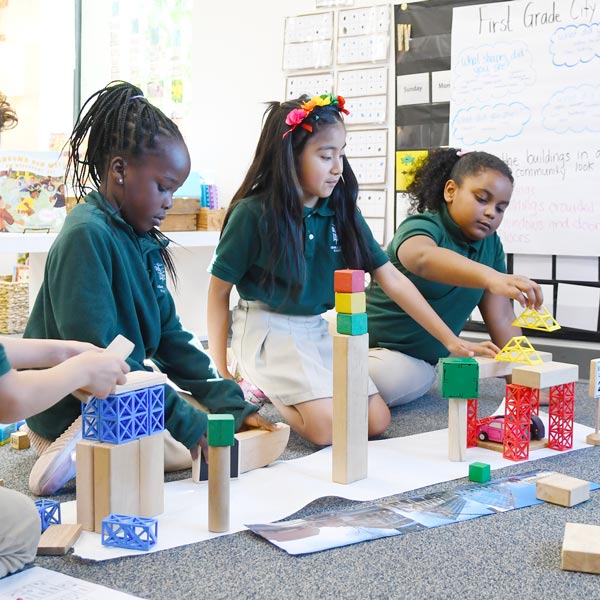
Key Findings from 50+ Years of Play-Based Learning Research
Across studies of guided play, playful learning, and play-based classrooms, research finds strong outcomes for learning, engagement, and wellbeing.
Commonly reported outcomes include:
- Academic gains, especially when play is purposeful and aligned to goals
- Stronger social-emotional development and self-regulation
- Higher student engagement and positive classroom climate
- Benefits for teacher practice and well-being when implementation is supported
Play-Based Learning vs Direct Instruction: What the Research Suggests
Many findings suggest that play-based learning can be especially effective for learners in the primary grades because of its emphasis on learning through active, social, meaningful, and student-directed engagement with school curriculum. This practice aligns with children’s developmental needs and abilities–and they way their brains naturally learn.
Why Play-Based Learning Works in Elementary School
Play-based learning in primary grades develops working memory, cognitive flexibility, and self regulation, as well as engaging children in problem solving, goal setting, planning, and other executive functions (Allee-Herndon & Roberts, 2021; Blyth, 2023; Buldu & Buldu, 2025; Nicholson, et al., 2016; Pahutar, et.al., 2024; Taylor & Boyer, 2020).
Primary school provides an ideal time to engage children in play-based learning because play builds foundational skills and that active engagement helps knowledge stick with them throughout their academic careers and in life (Allee-Herndon & Roberts, 2021; Graue, et al., 2025; Immordino-Yang & Damasio, 2007; Pahutar, et.al., 2024).
Play-based learning strengthens understanding by providing opportunities for children to build on what they already know and grow knowledge and skills through interacting with their peers and their environment (Dubinsky & Hamid, 2024; Pahutar, et.al., 2024; Taylor & Boyer, 2020).
Play-Based Learning in Practice
The Classroom
Successful play-based classrooms are well organized and not overly stimulating or busy. There is space for students to interact with one another and move about the classroom, encouraging a variety of learning modalities (Graue, et al., 2025; Nicholson, et al., 2016).
Routines are based on clear and shared expectations, promote student autonomy, and allow for sufficient time allotted for learning through play. Transitions are used as learning or foreshadowing opportunities (Buldu & Buldu, 2025; Goldberg, 2022; Graue, et al., 2025; Myung, et al., 2021).
Materials that best support play-based learning are identity-affirming (representing a variety of cultures, people, places, etc.), developmentally responsive, and accessible to students. Additionally, materials in a play-based learning classroom foster a sense of self-efficacy and offer opportunities for interaction among peers and teachers (Graue, et al., 2025; Klemp, et al., 2025; Pahutar, et.al., 2024; Taylor & Boyer, 2020; Xu, et al., 2025).
Activities are relevant to students’ lives, allow for a variety of goal achievement—from language and social skills development to knowledge acquisition—and provide opportunities for a variety of student and teacher direction and play modalities (Buldu & Buldu, 2025; Goldberg, 2022; Graue, et al., 2025; Myung, et al., 2021; Pica, 2025; Taylor & Boyer, 2020).
Neuroscience research tells us that environments that best support positive and productive learning experiences have (Goldberg, 2022; Gottfried, et al., 2025; Myung, et al., 2021; Xu, et al., 2025):
- Emotional safety with secure relationships with adults and peers,
- Cognitive and sensory-motor challenges,
- Opportunities for exploration,
- Scaffolded learning that encourages taking risks and learning through trial and error.
Planning and Implementation
Play-based learning works when it is thoughtfully and intentionally implemented. Educators must consider (Goldberg, 2022; Larsen, et al., 2025; Taylor & Boyer, 2020):
- The academic content and curriculum goals that children need to learn
- How the students in their classroom need to have content and activities presented in order to fully understand them
- The prior knowledge, skills and interests that students will draw on when learning current material and skills
- Are the activities and content developmentally appropriate and fit the needs of students?
Create a research-backed, collaboratively-developed school play policy that defines and explains (Stevens-Smith & Stegelin, 2015):
- what play-based learning looks like in the classroom
- why the school values play-based learning as an approach to effective teaching and learning
- why play is developmentally appropriate
- social-emotional gains
- benefits for students and teachers
The Teacher’s Role in Play-Based Learning
When teachers interact with children as a guide in play-based activities, they can increase time, depth of exploration, and focus on that activity (Taylor & Boyer, 2020; Xu, et al., 2025).
Teachers’ perceptions of the role of play in academic education influence what, how, when and why they implement play in their classrooms (Buldu & Buldu, 2025; Taylor & Boyer, 2020).
Collaborative play that is guided by teachers who take into account student interests, along with learning goals, has been found to be one of the most effective and supportive models for learning (Allen, et al., 2025; Taylor & Boyer, 2020).
Elements of successful teacher interactions (Buldu & Buldu, 2025; Graue, et al., 2025; Myung, et al., 2021; Pahutar, et al., 2024; Taylor & Boyer 2020):
- Positivity that encourages a safe, caring space and acknowledges children’s capacity to learn and engage in content,
- Responsiveness, including drawing on children’s experiences and interests,
- Scaffolding learning and communication in a variety of ways, including prompting questions and observations,
- Creating opportunities for student input, discussion and social interactions,
- Introducing new information, vocabulary and explanations through feedback loops,
- Providing context for activities,
- Offering positive reinforcement and constructive feedback focused on actionable items that students are capable of improving,
- Fostering positive relationships and a sense of belonging,
- Giving students a say in their learning.
Gains in Math, Literacy, and Science
Integrating science concepts into captivating stories can bridge the gap between abstract ideas and children’s everyday experiences, making science more relevant and accessible (Cho, 2024).
Play-based learning is more effective than direct instruction in developing early math skills, shape knowledge and spatial vocabulary (Skene, et al., 2022; Vogt, et al., 2018).
Children taught math and reading skills through play-based learning showed higher gains than children learning through direct instruction. This is particularly true for children who are struggling to achieve academic goals (Allee-Herndon, et al., 2022; Skene, et al., 2022; Taylor & Boyer, 2020).
An Entry Point for Every Student
Since children come into kindergarten with a wide array of competencies and experiences with math fundamentals, a play-based learning approach was better able to help all students learn those fundamentals (Vogt, 2018).
Play-based learning reduces stress and builds a positive environment for learning that most ideally supports disadvantaged learners (Allee-Herndon & Roberts, 2021).
Purposeful, goal-focused and developmentally-appropriate play-based learning shows promise as an effective pedagogy for addressing the achievement gap and helping students facing poverty and other adverse conditions (Allee-Herndon, et al., 2022).
Classrooms that foster secure relationships, present cognitive and sensory-motor challenges, provide opportunities for exploration and scaffolding that supports learning through trial and error build resilient learners. These components are particularly important for the wellbeing and success of students from disadvantaged backgrounds or those with learning disabilities (Goldberg, 2022).
Assessment in Play-Based Learning
Concerns about accountability and meeting academic standards often hinder play-based practice in the classroom (Pyle, et al., 2020; Taylor & Boyer, 2020).
It is important that administrators and teachers understand the purpose of play in what the students are learning. Some research-backed guidelines include (Taylor & Boyer, 2020):
- Be clear on the goals of the play-based activity before implementing.
- Identify what skills and abilities to be assessed before starting the activity.
- Measures that can be effectively used to assess are: teacher’s observational notes, checklists, photos, iPads.
Tools used by teachers to document children’s learning: portfolios that go back and forth from school to home, documentation mediums/materials for students to record what they know before a lesson, what they learned and what they still want to learn (Buldu & Buldu, 2025).
Professional development and education on assessing and addressing student skills and curriculum goals is necessary to be sure that both academic and SEL goals are being addressed when using play-based learning (Larsen, et al., 2025).
Use a variety of “non-test” assessments to help teachers understand student needs and help them grow, as opposed to final judgements on student abilities or intelligence—and communicate that with students (Myung, 2021).
Outcomes of Play-Based Learning
Studies show significantly higher learning outcomes for students taught through play-based learning. A play-based approach benefits children of all competency levels (Schweinhart, 2004; Schweinhart, et al. 2005; Taylor & Boyer, 2020; Vogt, 2018).
The social benefits that ultimately set children up for success in school and in life are developed and enhanced through play-based learning: communication skills; collaboration; vocabulary; self-regulation; social interactions such as sharing, taking turns and following rules; problem solving; conflict resolution; and expression of ideas and feelings (Larsen, et al., 2025; Nicholson, et al., 2016; Taylor & Boyer, 2020).
Play-based learning is supported by evidence-based research as an effective pedagogy for successful academic outcomes and strong social-emotional development (Taylor & Boyer 2020; Winthrop, et al., 2025). Additionally, many of the most accepted theoretical frameworks in child development support play-based learning as a preferred approach to teaching children (Taylor & Boyer, 2020).
Beyond Elementary School: Playful Learning for All Ages
Even high school, college and professional development benefit from intentional, goal-oriented play because it enlists a positive approach to education that encourages knowledge retention, and the further development of executive functioning and social-emotional skills (Allee-Herndon & Roberts, 2021; Blinkoff, et.al., 2023).
The Science Behind Play and Learning
Developmental
Kindergarteners are naturally motivated to learn, but they are not able to learn in a formal, lecture-based way or through worksheets, so play-based learning is a uniquely powerful and effective pedagogy for this age group (Pica, 2025; Pyle, et al., 2020; Vogt, 2018).
Motivation
The most positively impactful teaching practices are intentional, offer appropriate challenges, open the door for student-motivated learning and provide a balance of autonomy, social support, and scaffolding in pursuit of academic and social-emotional goals. These practices work because they follow the way the human brain naturally learns and rewards itself (Buldu & Buldu, 2025; Goldberg, 2022; Klemp, 2025; Nicholson, et al., 2016).
When students find content interesting and relevant, they are more motivated to put effort into learning and more likely to retain information because they can make more associations (Dubinsky & Hamid, 2024; Gottfried, et al., 2023; Pahutar, 2024).
Emotional
Emotions have a direct effect on how our brain processes information, thereby making a direct impact on how teachers teach and how students learn. Classrooms that support positive emotions have students that are more creative, intrinsically motivated, engaged, resilient and productive. Students also develop stronger social skills, emotional regulation, knowledge recall and skill application (Immordino-Yang & Damasio, 2007; Pahutar, et al., 2024; Xu, et al., 2025).
When students feel stressed, anxious, or frustrated, their cognitive functioning and motivation are negatively impacted because their bodies are releasing cortisol in greater amounts. The excess cortisol causes students to have decreased focus, content recall, knowledge storage and long-term skill retention (Pahutar, et al., 2024).
Play reduces stress and builds a positive environment for learning that most ideally supports disadvantaged learners (Allee-Herndon & Roberts, 2021).
Social
Peer-to-peer interactions further learning and keep students engaged and motivated. Neuroscience shows that positive social interactions such as mutual cooperation and sharing enhance learning (Dubinsky & Hamid, 2024; Taylor & Boyer, 2020).
Teachers that were able to lightly scaffold child-directed learning with academic goals were also able to help develop students’ SEL skills (Buldu & Buldu, 2025; Goldberg, 2022; Larsen, et al., 2025).
Social interactions among peers and with teachers build resilience and a sense of belonging, which creates a safe space for children to learn from academic challenges and learn life skills such as conflict resolution, sharing, resilience, collaboration and communication (Allen, et al., 2025; Goldberg, 2022; Xu et al., 2025).
Active Engagement
Processes that improve student learning, such as hands-on applications, problem solving, spacing out new content in smaller “doses” throughout time and connecting content to previous knowledge and multiple disciplines, require that students are actively engaging in the learning process (Blinkoff, et.al., 2023; Dubinsky & Hamid, 2024).
Moving about the classroom and interacting with peers not only improves student behavior, but also sets the stage for engaged learning because it aligns with the way children learn. Classrooms that encourage movement and social interaction through goal-oriented, play-based activities foster social-emotional development, reduce stress, and are more joyful than traditional classrooms. These classrooms are more likely to have fewer behavior challenges and more engaged, productive learners (Pica, 2025).
Agency
Studies show that when students feel successful in their learning and have agency over it, their brains generate more reward signals (Dubinsky & Hamid, 2024).
Trial and Error
Having the opportunity to recognize mistakes and learn from them is a hallmark for effective learning. When classrooms encourage learning from trial and error, deeper student understanding and learning transfer are far more likely to occur (Dubinsky & Hamid, 2024; Goldberg, 2022; Myung, et al., 2021).
Proven Benefits
Explore the research-backed benefits of play-based learning, including academic learning, engagement, attendance, wellbeing, equity, and classroom climate.
References
Allee-Herndon, K.A. & Roberts, S.K. (2021). The Power of Purposeful Play in Primary Grades: Adjusting Pedagogy for Children’s Needs and Academic Gains. Journal of Education, Vol. 201(1) 54–63. https://www.researchgate.net/publication/339002617_The_Power_of_Purposeful_Play_in_Primary_Grades_Adjusting_Pedagogy_for_Children%27s_Needs_and_Academic_Gains
Allee-Herndon, K., Roberts, S. K., BiYing, H., Clark, M. H., & Stewart, M. L. (2022). Let’s talk play! Exploring the possible benefits of play-based pedagogy on language and literacy learning in two title I kindergarten classrooms. Early Childhood Education Journal, 50(1), 119-132. https://doi.org/10.1007/s10643-020-01141-6
Allen, E.A., Redish, D., & Kizilcec, R.F. Fundamental Mechanisms of Human Learning: Implications for Research and Practice in Education. arXiv:2509.17202v2 [Preprint]. October 17, 2025. [cited 2025 December 1]. https://doi.org/10.48550/arXiv.2509.17202
Blinkoff, E., et.al. (2023). Investigating the contributions of active, playful learning to student interest and educational outcomes. Acta Psychologica, vol. 238. https://doi.org/10.1016/j.actpsy.2023.103983
Blyth, J. (2023). Play-Based Learning: Playing the Way to Rich Learning. BU Journal of Graduate Studies in Education, Volume 15. Retrieved from: https://files.eric.ed.gov/fulltext/EJ1398486.pdf
Buldu, M., & Buldu, E. (2025). How to promote playful learning: Insights from innovative early childhood classrooms in the USA. Humanities & Social Sciences Communications, 12(1), 1566. doi:https://doi.org/10.1057/s41599-025-05291-z
Cho, K. (2024). Story-driven embodied play: Empowering young Children’s agency in science learning. Early Childhood Education Journal, 52(7), 1577-1585. doi:https://doi.org/10.1007/s10643-023-01570-z
Dubinsky, J.M. & Hamid, A.A. (2024) The neuroscience of active learning and direct instruction, Neuroscience & Biobehavioral Reviews, Volume 163. ISSN 0149-7634. https://doi.org/10.1016/j.neubiorev.2024.105737
Goldberg, H. (2022). Growing Brains, Nurturing Minds—Neuroscience as an Educational Tool to Support Students’ Development as Life-Long Learners. Brain Sciences, 12(12), 1622. https://doi.org/10.3390/brainsci12121622
Gottfried, M.A., Ansari, A., & Woods, S.C. (2025). Do Teachers With Absent Students Feel Less Job Satisfaction? Educational Researcher, Vol. 54 No. 1, pp. 34–45. DOI: 10.3102/0013189X241292331. https://journals.sagepub.com/doi/10.3102/0013189X241292331
Graue, M. E., Chang, F., Ramberg, E., & Kim, Y. J. (2025). Developing an observational tool to support play-based teaching. American Journal of Play, 17(2), 161-193. Retrieved from https://www.proquest.com/scholarly-journals/developing-observational-tool-support-play-based/docview/3269933933/se-2
Immordino-Yang, M.H. and Damasio, A. (2007), We Feel, Therefore We Learn: The Relevance of Affective and Social Neuroscience to Education. Mind, Brain, and Education, 1: 3-10. https://doi.org/10.1111/j.1751-228X.2007.00004.x
Klemp, G., et al. (2025). What does well-being at school mean to primary school students? Children’s understanding of basic psychological needs. International Journal of Educational Research Open, vol. 8. https://doi.org/10.1016/j.ijedro.2025.100442
Larsen, N., Pyle, A., Danniels, E., Marzouca, M., & Nazeem, R. (2025). Kindergarten teachers’ facilitation of social and emotional learning in classroom play contexts. Education Inquiry, 16(2), 195-216. doi:https://doi.org/10.1080/20004508.2023.2192900
Myung, J., Kimner, H., Cottingham, B., Diaz Luna, S., Shiels, S., & Hough, H. (2021). Restorative restart: The path towards reimagining and rebuilding schools [Report]. Policy Analysis for California Education. https://edpolicyinca.org/publications/restorative-restart
Nicholson, J., Bauer, A., & Woolley, R. (2016). Inserting child-initiated play into an American urban school district after a decade of scripted curricula: Complexities and progress. American Journal of Play, 8(2), 228-271. Retrieved from: https://www.proquest.com/scholarly-journals/inserting-child-initiated-play-into-american/docview/1786464083/se-2
Pahutar, A.A., et.al. (2024). Emotions And Brain Processes In The Learning Process. Edu Global: Jurnal Pendidikan Islam, Vol. 5 No.2; 31-38. https://doi.org/10.56874/eduglobal.v5i2.2142
Pica, R. (2025). How play-based curricula help reduce challenging behaviors in ECE. Teachers College Press Blog. Retrieved November 2025: https://www.tcpress.com/blog/play-based-curricula-reduce-challenging-behaviors-ece/
Pyle, A., Pyle, M. A., Prioletta, J., & Alaca, B. (2020). Portrayals of play-based learning. American Journal of Play, 13(1), 53-86. Retrieved from https://www.proquest.com/scholarly-journals/portrayals-play-based-learning/docview/2545263627/se-2
Schweinhart, L. J., Montie, J., Xiang, Z., Barnett, W. S., Belfield, C. R., & Nores, M. (2005). Lifetime effects: The HighScope Perry Preschool study through age 40. Ypsilanti, MI. HighScope Press.
Schweinhart, L. J. (2004). The High/Scope Perry Preschool Study Through Age 40: Summary, Conclusions, and Frequently Asked Questions. Ypsilanti, MI: HighScope Press. https://highscope.org/wp-content/uploads/2024/07/perry-preschool-summary-40.pdf
Skene, K., O’Farrelly, C. M., Byrne, E. M., Kirby, N., Stevens, E. C., & Ramchandani, P. G. (2022). Can guidance during play enhance children’s learning and development in educational contexts? A systematic review and meta-analysis. Child Development, 93(4), 1162–1180. https://academic.oup.com/chidev/article/93/4/1162/8255052
Stevens-Smith, D., & Stegelin, D. A. (2015). Making connections between play and healthy development: Reasons to promote play-based learning environments. The International Journal of Early Childhood Learning, 23(2), 1-13. doi:https://doi.org/10.18848/2327-7939/CGP/v23i02/48454
Taylor, M.E. & Boyer, W. (2020). Play-Based Learning: Evidence-Based Research to Improve Children’s Learning Experiences in the Kindergarten Classroom. Early Childhood Education Journal; 48:127–133. https://doi.org/10.1007/s10643-019-00989-7
Vogt, F., et.al. (2018). Learning through play – pedagogy and learning outcomes in early childhood mathematics. European Early Childhood Education Research Journal, 26:4, 589-603, https://doi.org/10.1080/1350293X.2018.1487160
Winthrop, R., Showery, Y., & Nitkin, D. (2025) The Disengagement Gap: WhyStudent Engagement Isn’t What Parents Expect. Brookings Institution. Retrieved from: https://www.brookings.edu/articles/the-disengagement-gap/
Xu, Y. , et al. (2025). A case study of a teacher’s extrinsic emotion regulation on students’ positive emotions and learning experience. International Journal of Educational Research, 134. https://doi.org/10.1016/j.ijer.2025.102811